
Homemade Protein Treatment for Relaxed Hair Guide
Relaxed hair can look smooth and polished on the outside while still feeling weak, dry, or fragile underneath. If your hair snaps easily, feels limp, or seems to be thinning out from breakage rather than shedding, you are not alone in searching for answers.
A homemade protein treatment for relaxed hair is one option people turn to when their strands need extra strength. Before reaching for a recipe, though, it helps to understand what a protein treatment actually does, whether your hair is a good candidate for one, and how to use it without causing more harm than good.
This guide walks through all of that, along with simple recipes, application steps, and the signs that tell you when protein is helping or when it is time to pull back.
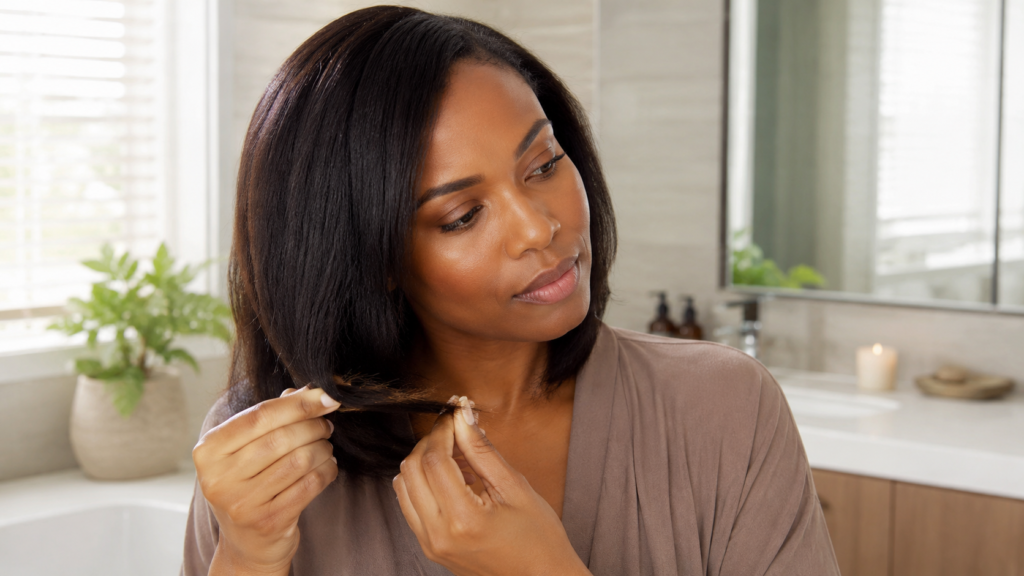
What Is a Protein Treatment for Relaxed Hair?
A protein treatment is designed to temporarily reinforce the structure of the hair strand. Hair is made mostly of a protein called keratin, and chemical processes like relaxing can wear down parts of that structure over time.
Chemically treated hair, including relaxed hair, can benefit from occasional strengthening care because the relaxing process alters the hair’s internal bonds. This can leave strands more porous and more prone to breakage than hair that has never been chemically treated.
It helps to understand the difference between protein and moisture. Protein adds strength and structure, while moisture adds softness and flexibility. Relaxed hair typically needs both, not just one or the other, and leaning too heavily on protein without enough moisture can leave hair feeling stiff rather than healthy.
The goal with protein treatment for relaxed hair is balance, not constant strengthening. Most relaxed hair does better with occasional protein care paired with regular moisture, rather than frequent protein treatments on their own.
Can You Use a Homemade Protein Treatment on Relaxed Hair?
Yes, in many cases a homemade protein treatment can be a reasonable option for relaxed hair, but it depends on your hair’s current condition.
When it may make sense:
- Your hair feels weak or overly soft, especially when wet
- You notice more breakage than usual, without scalp irritation
- Your hair has gone several weeks since your last relaxer application
- You want a simple, occasional strengthening step between salon visits
When to avoid it:
- Your scalp feels irritated, tender, or recently burned from a relaxer application
- Your hair already feels hard, stiff, or brittle
- You have applied protein treatments recently without much recovery time
- You are experiencing sudden or unexplained hair loss
Because everyone’s hair responds differently, it is worth doing a small test on one section of hair before treating your entire head. This lets you see how your hair reacts to a specific homemade hair treatment for damaged relaxed hair before committing to a full application.
Best Homemade Protein Treatment Options for Relaxed Hair
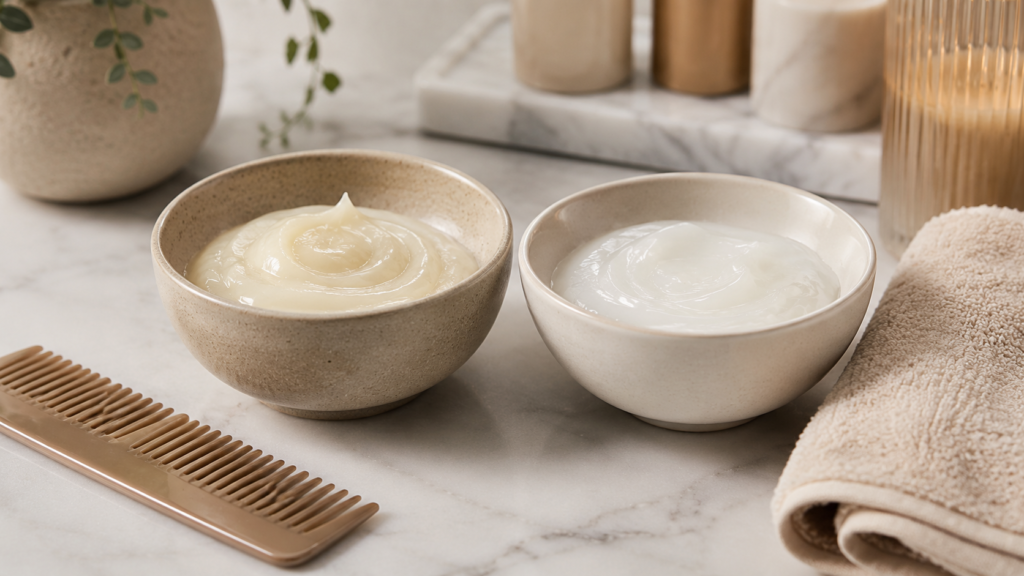
Here are three simple, realistic options. Each works a little differently, so choose based on what your hair needs and what you have on hand.
1. Egg-Based Conditioning Protein Treatment
Ingredients:
- 1 whole egg
- 2 tablespoons olive oil
- 1 tablespoon honey
What it is intended to do: Eggs contain natural protein along with fats that add mild conditioning. This option is a gentle way to introduce some protein support without being overly strong.
Who may prefer it: Those with mild to moderate weakness who want a soft introduction to protein treatments rather than an intensive one.
How to prepare it: Whisk the egg until smooth, then stir in the olive oil and honey until fully combined.
How to apply it: Apply to clean, damp hair in sections, focusing on the lengths and ends where relaxed hair tends to be most fragile.
How long to leave it on: 15 to 20 minutes under a shower cap.
How to rinse it: Rinse with cool to lukewarm water to avoid cooking the egg in your hair.
What to do afterward: Follow immediately with a moisturizing conditioner to restore softness.
2. Yogurt-Based Conditioning Treatment
Ingredients:
- 4 tablespoons plain yogurt
- 1 tablespoon honey
- 1 teaspoon coconut oil
What it is intended to do: Yogurt offers a gentler source of protein along with added moisture, making this a good middle-ground option for hair that needs light strengthening without feeling harsh.
Who may prefer it: Those whose hair leans more toward dryness than severe weakness, or who want a treatment that leans slightly more moisturizing.
How to prepare it: Mix all three ingredients until smooth and well combined.
How to apply it: Apply section by section to damp hair, concentrating on mid-lengths to ends.
How long to leave it on: 20 minutes under a shower cap.
How to rinse it: Rinse thoroughly with lukewarm water.
What to do afterward: Follow with a lightweight conditioner if hair feels like it needs extra softness.
3. Hydrolyzed Protein and Conditioner Blend
Ingredients:
- 1 tablespoon commercially available hydrolyzed protein liquid or powder (such as hydrolyzed wheat or silk protein)
- 3 tablespoons regular conditioner
What it is intended to do: This option combines a professionally formulated hydrolyzed protein with a conditioner base. It is worth noting that hydrolyzed protein products are manufactured with tested, consistent protein levels, which is different from the natural protein found in kitchen ingredients like egg or yogurt.
Who may prefer it: Those who want more predictable strengthening than a fully homemade mixture can offer, while still keeping the process simple and low-cost.
How to prepare it: Stir the hydrolyzed protein into the conditioner until evenly blended.
How to apply it: Apply through damp, sectioned hair, focusing on areas that feel weakest.
How long to leave it on: Follow the instructions on the hydrolyzed protein product, since concentration varies by brand.
How to rinse it: Rinse thoroughly with cool to lukewarm water.
What to do afterward: Follow with a separate moisturizing conditioner if your hair feels firm after rinsing.
How to Apply a Homemade Protein Treatment to Relaxed Hair
- Detangle gently with a wide-tooth comb before applying anything, working from ends to roots.
- Divide hair into sections, using four to six clips to keep the process manageable.
- Apply mainly to the lengths and fragile areas, since relaxed hair often shows the most damage from mid-length to ends rather than at the roots.
- Avoid aggressive rubbing while applying, since relaxed hair can be more fragile when wet and saturated with product.
- Follow the recommended processing time for whichever recipe you are using, rather than guessing or extending it.
- Rinse thoroughly with cool to lukewarm water until the product is fully out.
- Follow with a moisturizing conditioner to help balance the strengthening effect and restore softness.
- Dry and style gently, avoiding excessive heat or tension right after treatment, especially if your hair still feels delicate.
How Often Should You Do a Protein Treatment on Relaxed Hair?
There is no single schedule that works for every head of relaxed hair. How often to use a protein treatment on relaxed hair depends on your hair’s current condition:
- Mildly weak hair: Once every four to six weeks may be enough to maintain strength without overdoing it.
- Noticeably damaged hair: More frequent, gentle protein care may help, but should still be paired with regular moisture and monitored closely for signs of stiffness.
- Hair that feels stiff after protein: This is a signal to pause treatments entirely and shift focus to moisture-based conditioning for several weeks.
- Healthy hair that only needs maintenance: Protein treatments every six to eight weeks, or even less often, are often sufficient.
More protein is not automatically better. Once hair reaches a point of feeling strong and manageable, adding more protein can tip the balance in the wrong direction.
Protein Treatment vs Moisture Treatment for Relaxed Hair
| work | Protein Treatment | Moisture Treatment |
|---|---|---|
| Main purpose | Strengthens and reinforces weak areas of the strand | Softens and hydrates dry, brittle-feeling hair |
| How hair may feel afterward | Firmer, more structured | Softer, more flexible |
| When it may be useful | Hair feels weak, overly elastic, or breaks easily | Hair feels dry, dull, or stiff |
| What overuse can cause | Hard, brittle, stiff-feeling strands | Limp, overly soft strands with reduced structure |
| What relaxed hair needs from each | Occasional reinforcement, not constant use | Regular, consistent hydration as a routine staple |
Relaxed hair generally needs more frequent moisture than protein. Think of protein as an occasional support step and moisture as the ongoing foundation of a healthy routine.
Signs Your Relaxed Hair May Need Protein
- Excessive snapping, especially during combing or styling
- Hair that feels unusually weak, lacking its normal structure
- Poor elasticity, where strands do not spring back after stretching
- Breakage during manipulation, such as detangling or twisting
- Hair that feels overly soft and seems to lack any firmness
These signs can have more than one cause, including dryness, product buildup, or simply time since your last trim. They do not automatically mean your hair needs protein, so it helps to consider your recent routine before assuming protein is the fix.
Signs You May Be Overdoing Protein
- Hair feels hard or stiff, even after conditioning
- Rough texture that does not smooth out with product
- Increased tangling, more than usual
- More breakage after treatment, rather than less
- Hair loses flexibility, feeling rigid rather than pliable
If you notice these signs, pause protein treatments and shift your focus to gentle, moisture-based conditioning care for a few weeks. Give your hair time to soften and rebalance before considering protein again.
Common Mistakes to Avoid
- Using protein too frequently, without allowing recovery time between treatments
- Leaving a homemade mixture on too long, assuming longer processing means better results
- Applying it to an irritated scalp, which can worsen sensitivity or discomfort
- Skipping moisturizing conditioner afterward, leaving hair feeling stiff
- Detangling aggressively, which increases the risk of breakage on fragile relaxed hair
- Assuming every breakage problem is caused by protein deficiency, when dryness or over-manipulation may be the real cause
- Using too many ingredients at once, which can make a recipe harder to rinse out and less predictable
- Expecting permanent repair from a DIY treatment, when the real benefit is temporary strengthening
How to Care for Relaxed Hair After a Protein Treatment
- Gentle detangling, using a wide-tooth comb and working in small sections
- Moisture-focused conditioning in the days following, to keep hair balanced
- Low-manipulation styling, giving hair a break from heavy manipulation
- Reduce excessive heat, especially right after treatment while hair may still feel delicate
- Protect hair at night, using a satin or silk covering to reduce friction
- Keep ends conditioned, since ends are typically the oldest and most fragile part of relaxed hair
- Avoid overlapping relaxer applications, which can compound existing damage
- Watch for ongoing breakage, and adjust your routine if it continues despite these steps
When a Homemade Protein Treatment Is Not the Best Choice
Some situations call for caution rather than a DIY approach:
- Scalp irritation or chemical burns, which need time to heal before any treatment is applied
- Severe breakage that does not improve with basic care adjustments
- Sudden or unexplained hair loss, which may point to something beyond a protein and moisture imbalance
- Hair that feels extremely brittle, to the point of snapping with minimal handling
- Recently relaxed hair that is already irritated, since adding more product can increase discomfort
- Persistent problems despite changing your routine, suggesting the issue may need a closer look
In these situations, it is worth seeking advice from a qualified hairstylist or, for scalp or hair loss concerns, a healthcare professional. A homemade treatment is not a substitute for proper evaluation when something feels seriously wrong.
Frequently Asked Questions
What is the best homemade protein treatment for relaxed hair? There is no single best option, since it depends on your hair’s condition. A mild egg or yogurt-based treatment works well for light strengthening, while a hydrolyzed protein and conditioner blend offers more predictable results.
How often should I use a protein treatment on relaxed hair? This depends on your hair’s condition, but a common starting point is every four to six weeks, adjusted based on how your hair feels afterward.
Is egg good for relaxed hair? Egg can offer mild natural protein and is generally well tolerated, though it should be rinsed with cool water and avoided by anyone with an egg allergy.
Can too much protein damage relaxed hair? Too much protein will not cause structural damage in the same way as chemical processing, but it can leave hair feeling hard, stiff, and more prone to breakage until the balance is restored with moisture.
Should I moisturize after a protein treatment? Yes, following a protein treatment with a moisturizing conditioner helps restore softness and keeps hair from feeling overly firm or stiff.
How do I know if my relaxed hair needs protein? Signs like excessive snapping, poor elasticity, and breakage during styling can point to a need for protein, though these signs can also stem from dryness or over-manipulation.
Can I use a protein treatment after relaxing my hair? It is best to wait until your scalp and hair have settled and any irritation has fully resolved before introducing a protein treatment, typically a couple of weeks after relaxing.
What is the difference between protein and moisture for relaxed hair? Protein adds strength and structure to the strand, while moisture adds softness and flexibility. Relaxed hair generally needs both, with moisture as the more frequent, ongoing need.
Final Verdict
Relaxed hair thrives on balance rather than extremes. A homemade protein treatment can genuinely help strengthen hair that feels weak or prone to breakage, but it works best as an occasional step, not a constant one.
Moisture and gentle handling matter just as much as protein, especially for hair that has already been through chemical processing. There is no single treatment that works for every head of relaxed hair, so pay attention to how your own hair responds, adjust as needed, and reach out to a professional if something feels persistently off.